
SEO, AIO & AI Listings for Apps (2026 Guide)
By Sagar Joshi
Published · Last updated
App listing SEO is no longer a side project for mobile teams—it is the bridge between Google, AI answer engines, and the install button on your store page. If you only optimize keywords inside the App Store or Google Play, you are fighting for half the discovery map. The other half is open web search, Google AI Overviews, and conversational tools that recommend apps without showing a traditional blue-link results page.
This guide is for indie developers and mobile marketers who already understand that screenshots matter, but need a single system for SEO, AIO (answer engine optimization), and AI-ready listings—without repeating generic marketing advice or duplicating pure ASO tutorials already on the Nakxi blog.
What most SEO guides miss about app discovery
We reviewed the five articles that currently dominate queries blending SEO, GEO/AEO, and AI search—sources like Keo Marketing’s AEO vs SEO vs GEO breakdown, Beamtrace’s AI SEO guide, Yotpo’s AI search engine strategies, Seafoam’s GEO primer, and Foes’ B2B SEO/AEO/GEO playbook.
What they agree on:
- Layer SEO → AEO/AIO → GEO instead of replacing one with another.
- Front-load answers (40–60 words) under question-style headings for extraction.
- Use schema markup, FAQs, freshness, and third-party entity signals.
- Track AI citations and referral traffic separately from classic organic clicks.
The gap this article fills:
None of those pieces connect discovery to mobile store listings as a product surface—screenshot OCR, visual trust, category framing, or the speed at which you can ship localized creatives when AI models surface your app in a comparison answer. They also treat “listings” as web pages, not as App Store and Google Play assets that must match what AI just promised the user.
That is the contrarian, practical take for 2026: AI recommendations are only as credible as your listing looks when the user lands. A text-perfect FAQ on your website plus amateur screenshots on the store page is a broken funnel—and AI systems that scrape reviews and visual signals will notice the mismatch over time.
Table of contents
- Why discovery split into three channels
- App listing SEO: owning search outside the store
- AIO: getting extracted and cited by answer engines
- AI listings: when the store page must match the AI pitch
- The Listing Visibility Stack framework
- SEO vs AIO vs ASO: comparison matrix
- 90-day implementation roadmap
- How visuals and screenshots fit the stack
- Measurement: what to track in 2026
- FAQ
- Conclusion
Why discovery split into three channels
App listing SEO is how people find you on the open web. AIO is how machines quote you in synthesized answers. AI listings are how you convert that attention inside Apple and Google storefronts—where the user still decides in seconds.
Consider three user paths that now happen daily:
- A founder searches Google for best habit tracker app for ADHD → lands on a comparison blog → taps your site → jumps to the App Store.
- A student asks Perplexity what app do students use for flashcards with offline mode → sees three cited apps → opens the store listing for the one with the clearest first screenshot.
- A power user searches inside the App Store → scrolls screenshots only → installs without reading the description.
Each path rewards different work. Teams that only do ASO win path three. Teams that only do content SEO win path one but leak installs on path two and three. The goal of app listing SEO in 2026 is to align all three so the story is identical everywhere.
Apple reports that search drives roughly 65% of iOS app discoveries via App Store search and discovery surfaces (Apple Search Ads documentation). Globally, mobile usage still exceeds 140B annual downloads (Data.ai State of Mobile)—but an increasing share of consideration happens before the store, inside AI interfaces that never show your full description.
App listing SEO: owning search outside the store
App listing SEO means building crawlable, trustworthy web assets that rank for category and problem keywords—not just your brand name.
Pages every app should publish
| Page type | Primary job | Target queries |
|---|---|---|
| Product landing | Convert visitors to store clicks | Brand + category |
| Use-case hub | Match problem-aware search | “app for [job]” |
| Comparison | Win consideration queries | “[your app] vs [rival]” |
| Changelog / updates | Freshness signal | “[app] new features 2026” |
| Docs / help | Long-tail how-to SEO | “how to [task] in [app]” |
On-page rules that still work in 2026
- One clear H1 per page with the category noun (invoice scanner app, not Welcome to Our Product).
- Short paragraphs (2–4 sentences) and descriptive H2s—machines and humans both skim.
- Real E-E-A-T: named author, role, date updated, link to privacy policy and support contact.
- Internal links into your App Store screenshot generator and Play equivalents so crawlers understand product context.
Technical basics
- Submit sitemap in Google Search Console; fix Core Web Vitals on marketing pages.
- Add
SoftwareApplicationJSON-LD withapplicationCategory, operating system, andofferswhere accurate (Google structured data guidelines). - Keep canonical URLs stable—AI systems overweight consistent entity references.
This layer is informational intent: educate first, pitch second. Hard sells on blog posts reduce both rankings and AI citation trust.
AIO: getting extracted and cited by answer engines
Answer engine optimization (AIO)—sometimes labeled AEO or GEO—is the practice of formatting content so ChatGPT, Perplexity, Gemini, and Google AI Overviews can lift a direct answer and attribute it to you.
For mobile apps, the highest-leverage AIO assets are:
- Question headers that mirror natural language prompts (What is the best free scanner app for receipts?).
- First-sentence answers under each header (40–60 words, declarative, no fluff).
- FAQ blocks with
FAQPageschema—eight to twelve genuine questions, not keyword spam. - Verifiable facts—pricing model, platforms, data practices, release cadence—with dates.
Prompt patterns to optimize for
Run these in Perplexity or ChatGPT monthly and note who gets cited:
- Best [category] app for [audience]
- [Problem] app with offline mode / no subscription
- Alternatives to [competitor] for [use case]
- Is [your app] safe / worth it / still maintained
If competitors appear and you do not, your gap is usually entity depth (few third-party mentions) or extractability (answers buried in marketing prose).
Contrarian AIO tactic for apps
Publish a “How we compare” page that AI can quote honestly. Neutral tone beats superlatives. Include a table with feature rows you actually ship. AI models prefer passages they can defend; exaggerated claims get filtered out.
External benchmark: Google’s guidance on AI-generated search experiences stresses helpful, reliable, people-first content—the same bar applies when optimizing for third-party answer engines.
AI listings: when the store page must match the AI pitch
An AI listing is your App Store or Google Play presence tuned for the moment a user arrives after an AI recommendation—not only for store search keywords.
When an AI answer says “App X has offline flashcards and no account required,” the user scans your first two screenshots to confirm that claim in under seven seconds. If screenshots show generic UI with no headline, the recommendation feels wrong—even if the feature exists on screen five.
Store-side checklist for AI-aligned listings
- Screenshot 1: Repeat the promise AI made (outcome headline, not logo splash).
- Screenshot 2–3: Proof—UI state, metric, or social proof that backs the claim.
- Subtitle / short description: Same vocabulary as your web FAQ (helps OCR + human scan).
- Reviews velocity: Recent reviews reinforce freshness signals algorithms and models both weight (ASO trends covered here).
- Localized sets: If AI cited you for a locale-specific query, show localized screenshots—not just translated metadata.
Apple’s increasing use of screenshot text in discovery means your visual copy is part of app listing SEO inside the store (see our ASO & screenshot design guide). Treat captions as indexable copy, not decoration.
The Listing Visibility Stack framework
Use the Listing Visibility Stack (LVS) to sequence work without boiling the ocean. Each layer unlocks the next.
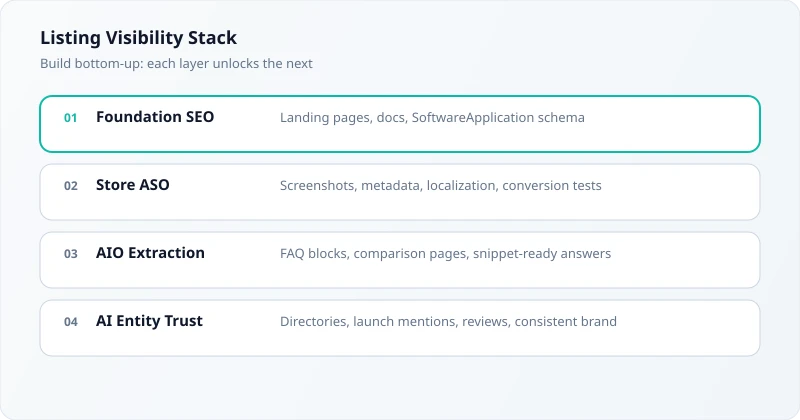
Layer 1 — Foundation SEO
Goal: Crawlable marketing site and docs that rank for category terms.
Outputs: Landing page, two use-case articles, sitemap, SoftwareApplication schema.
Done when: You rank page two–three for one non-brand query or receive organic traffic from comparison keywords.
Layer 2 — Store ASO
Goal: Win store search and convert browse traffic.
Outputs: Keyword map, optimized title/subtitle, screenshot storyboard, icon test.
Done when: Impression → product page view rate improves week over week. Use high-converting screenshot workflows as your build standard.
Layer 3 — AIO Extraction
Goal: Become quotable in AI answers.
Outputs: FAQ on site, comparison page, eight snippet-ready Q&A sections on blog posts (like this one).
Done when: Manual prompt tests cite your domain or app name at least twice per category cluster.
Layer 4 — AI Entity Trust
Goal: Reinforce that your app is a real, maintained product across the web—so AI models have third-party signals to cite, not just your own marketing site.
Outputs: Consistent naming everywhere, directory profiles, launch/press mentions, review velocity, changelog discipline.
Actionable steps (no Wikipedia required):
- Launch surfaces: Ship a crisp Product Hunt post, App Store / Play launch story, and a short “what’s new” post on your blog—each uses the same three proof points as your screenshots.
- Directories: Claim profiles on categories you actually fit (e.g. alternative-to lists, indie app directories, Crunchbase for funded teams)—use identical app name, icon, and one-line description.
- Press & quotes: Pitch niche newsletters or respond on HARO / Qwoted with founder quotes tied to a specific problem your app solves; one real citation beats ten directory spam links.
- Reviews: Ask engaged users after a success moment (export completed, streak hit)—recent reviews are a freshness signal stores and scrapers both notice.
- Social proof pages: A
/pressor/mentionspage listing logos, quotes, and embeds gives AI a single URL to verify claims. - Naming discipline: Same title spelling on site, stores, directories, and social bios—entity confusion is a silent citation killer.
Done when: Branded search volume rises, directory profiles are complete, and manual AI prompt tests repeat the same three strengths you publish on web and store.
Run layers 1 → 2 → 3 → 4 if you are pre-launch. Run 2 → 3 → 1 → 4 if you are post-launch with traffic but weak AI visibility. Never skip Layer 2—store conversion is where app listing SEO pays rent.
SEO vs AIO vs ASO: comparison matrix
| Dimension | SEO (web) | AIO (answer engines) | ASO / AI listings (stores) |
|---|---|---|---|
| Primary surface | Google/Bing results | ChatGPT, Perplexity, AI Overviews | App Store, Google Play |
| Success metric | Rankings, organic clicks | Citations, AI referral traffic | Impressions, conversion rate, installs |
| Core asset | Articles, docs, schema | FAQ blocks, direct answers | Screenshots, video, metadata |
| Intent | Informational → navigational | Recommendation / comparison | Transactional install |
| Update cadence | Monthly content | Refresh FAQs when features ship | Every release + A/B tests |
| Nakxi touchpoint | App Store screenshot generator mockups on landing pages; marketing templates for blog heroes | Export screenshot PNGs into FAQ/comparison pages as proof images | Play Store screenshot generator; device frames; one-click resize across store sizes; localized sets |
Secondary keywords mapped: answer engine optimization apps → Layer 3; AI app discovery → Layers 3–4; generative engine optimization mobile apps → Layers 3–4 plus honest comparison content.
90-day implementation roadmap
Days 1–30: Fix the install funnel
Example: A habit app sees traffic from TikTok but flat installs—the first screenshot is a logo splash. Week-one fix: headline “Build habits in 60 seconds” on frame one, proof screenshot on frame two.
- Audit your listing against the top three competitors in your category: note their first headline, frame count before pricing, and use of device frames.
- Map one primary promise per screenshot (outcome, proof, feature depth)—no duplicate messages across the carousel.
- Rebuild screenshots with benefit-first headlines using the 2026 size guide and conversion workflow.
- Run a subtitle + screenshot vocabulary pass so the same keywords appear in OCR-visible text and short description.
- Ship one localized screenshot set if Analytics or store reports show a non-English country in your top five territories.
- Set a baseline impression → product page view rate in App Store Connect / Play Console before you change creatives.
- Schedule a day-30 review: keep winners, replace only frames with below-median engagement if your store supports creative analytics.
Days 31–60: Publish extractable web content
Example: Publish /compare/[competitor] with a neutral feature table and an FAQ block—each H2 opens with a 50-word direct answer.
- Launch a comparison page and a category FAQ page with
FAQPage-ready Q&A pairs (question title + answer in the first paragraph). - Add
SoftwareApplicationJSON-LD on your product landing page (name, OS, category, price model). - Publish two use-case articles targeting “app for [job]” queries, each linking to the store with UTM parameters.
- Add a named author byline and visible last updated date on every resource page (this post follows that pattern).
- Embed one annotated store screenshot per major FAQ answer so web copy and visual proof align.
- Internally link hubs to the Play Store screenshot workflow and App Store generator.
- Submit updated URLs in Search Console and request indexing for new comparison/FAQ URLs.
Days 61–90: Close the AI loop
Example: After a pricing change, re-run “best free [category] app” in Perplexity—if the AI still cites old pricing, update FAQ + screenshot frame one the same day.
- Run weekly prompt tests in ChatGPT, Perplexity, and Gemini for five category questions; log who gets cited and which URL is quoted.
- Tag store outbound links with UTMs (
utm_source=chatgpt,utm_source=perplexity, etc.) and create a GA4 channel group for AI referrers. - Refresh FAQ answers within 48 hours of any pricing, platform, or flagship feature change.
- Iterate screenshot frame one whenever your AI pitch shifts (new hook, audience, or compliance claim).
- Complete two directory or launch profiles you have ignored (Product Hunt, niche directory, or newsletter feature).
- Add a
/pressor changelog entry summarizing the quarter’s shipped features with dates—freshness signal for crawlers and models. - Score the quarter: one non-brand SEO ranking, two AI citations, one store CVR lift—if any leg is zero, prioritize that layer next quarter.
How visuals and screenshots fit the stack
Visuals are not a separate design project—they are trust compression across SEO, AIO, and AI listings.
- Web: Hero mockups on landing pages should match store screenshot messaging so AI scrapers see consistent entities.
- AIO: Include one annotated screenshot per major FAQ answer so models associate features with UI proof.
- Store: Professional frames and typography signal maintenance quality; generic canvas exports signal risk.
Teams using a dedicated app store screenshot generator cut iteration time from days to hours—important because AI search rewards freshness and store algorithms reward recent creative tests. That speed is a competitive moat for solo developers who cannot run a full agency studio (see ASO growth studio without agency overhead).
If you are evaluating design tools, note that general-purpose editors lack device-safe zones and store resize pipelines—why Canva falls short for ASO creatives is a common lesson teams learn after a failed launch week.
Measurement: what to track in 2026
| Channel | Metric | Tooling |
|---|---|---|
| SEO | Non-brand clicks, ranking URLs | Search Console |
| AIO | Citation count, AI referral sessions | Manual prompts + analytics UTMs |
| ASO | Impressions, conversion, keyword rank | App Store Connect, Play Console, AppTweak-class tools |
| Visual ASO | CVR delta after screenshot test | Store experiments, SplitMetrics-class tools |
Set a simple scorecard: one SEO win, one AI citation, one store CVR lift per month. If all three move, your app listing SEO system is healthy.
FAQ
The questions below are also emitted as FAQPage JSON-LD on this URL (view page source or test in Google’s Rich Results Test)—the same pattern we recommend for your own comparison and product pages.
What is app listing SEO?
App listing SEO is optimizing web pages, structured data, and supporting content so your app ranks on Google and earns traffic before users open an app store.
What is AIO for mobile apps?
AIO for mobile apps is formatting FAQs, comparisons, and docs so answer engines can quote you when users ask recommendation questions in natural language.
How is generative engine optimization different from ASO?
Generative engine optimization (GEO) targets citations inside AI-generated answers across the web; ASO targets rankings and conversion inside Apple and Google stores. You need both, plus matching screenshots.
Do I need a blog if I am an app developer?
You need crawlable, helpful pages—a blog is the easiest format for FAQs and comparisons that power AIO. Even three strong pages beat fifty thin ones.
How often should I update screenshots for AI search?
Update when your primary promise changes—new feature, pricing, audience pivot—or when store experiments show fatigue, typically every 2–3 major releases.
Will AI replace App Store search?
No in 2026. Store search remains the largest mobile discovery channel for installs; AI expands top-of-funnel consideration. Neglecting either side leaks revenue.
What schema types matter most?
SoftwareApplication, FAQPage, Organization, and BreadcrumbList are the highest ROI for app publishers.
Can Nakxi help with SEO and AIO?
Nakxi is built for store-ready visuals and fast iteration—the Layer 2 and trust-signaling piece of the stack. Pair it with the web and FAQ work in Layers 1 and 3 for full coverage.
Conclusion
App listing SEO, AIO, and AI listings are three parts of one discovery system—not three competing projects. SEO brings strangers to your story. AIO makes that story quotable in ChatGPT, Perplexity, and Google AI Overviews. Your store listing closes the loop with screenshots and metadata that prove the AI was right to mention you.
Use the Listing Visibility Stack to prioritize layers, ship extractable FAQs, and keep visuals aligned across web and store. That is how indie developers and mobile teams rank in 2026 without doubling headcount.
Your Layer 2 is only as strong as your screenshots. When AI or Google sends users to your store, they decide in seconds whether your listing matches the promise. Design store-accurate creatives in Nakxi—right sizes, device frames, and localization in one session. Start free →